Oil Pump 12V 100W, Oil Extractor Pump for DIY Engine Oil Change
Oil Pump 12V 100W, Oil Extractor Pump for DIY Engine Oil Change
BUNDLE & SAVE
Couldn't load pickup availability
Safe & Secure Checkout
256-bit SSL encryption
protects every order.
30-Day Guarantee
Love it or get a full
refund. No hassle.

Oil Pump 12V 100W, Oil Extractor Pump for DIY Engine Oil Change
For everyone who’s done it the hard way
Change your oil standing up.
This little 12V pump pulls the old oil out through the dipstick tube. No jack, no drain plug, no hot oil running down your sleeve.
Warm the engine for a few minutes, slide the thin tube down the dipstick tube and clip the pump to your battery. The old oil climbs out the top and into a jug, while you stand there with clean hands.
- 12V DC
- 100W pure copper motor
- Up to 4.2 qt/min*
- Self-priming
- 3 hoses included

5 QT
The oil isn’t the hard part. Getting to it is.
About five quarts. That’s how much hot, black oil is sitting right above you when you crack the drain plug loose. To get there, you jack up the car, set the stands and slide under on cold concrete. On a lot of newer cars you unbolt a plastic splash shield first.
Then the plug lets go. Oil hits your knuckles, overshoots the pan and runs down your sleeve. You’ll smell it on your hands through dinner.
And that plug? On many engines it’s a steel bolt in a soft aluminum pan. Overtighten it once and the threads can strip. A new oil pan runs about $900 to $1,100 at a shop.

The old way
- Jack, stands and a slide across cold concrete
- Hot oil over your hand the second the plug lets go
- A drain plug that’s one heavy wrench away from stripped
- A mower tipped on its side, with oil in the air filter
The topside way
- You stay on your feet. The car stays on the ground.
- Oil goes from hose to jug. No open pan, nothing to slosh.
- The drain plug never moves, so it can’t strip or leak.
- The mower stays on its wheels and the filter stays dry.
Same engine. Same fresh oil. A lot less time on your back.
Wait, you can pull oil out through the dipstick tube?
Yes. The dipstick tube runs straight down into the oil pan, so it works like a built-in straw. Marinas change oil this way every day, because nobody can crawl under a boat engine. Plenty of dealership techs service European engines the same way. Even Briggs & Stratton lists an oil extractor as an acceptable way to drain its mower engines.
The method is old news. What’s new is a pump that does the pulling for you.
Built to pull five quarts uphill
It’s about 7 inches long and lives in a drawer. Inside is a 100-watt motor wound with pure copper and a pump head that starts pulling on its own.

-
100W motor, wound with pure copper
Look-alike pumps cut costs with copper-clad aluminum. This one uses 100% copper windings, which carry current better, so the pull stays strong and steady and the motor is built to last.
-
Primes itself
No squeeze bulb, no filling the hose first, no pumping a handle. Give it power and it draws the oil up the tube on its own.
-
Up to 4.2 quarts a minute*
That’s its top speed. Through the thin dipstick tube with warm oil, most car engines are empty in about 5 to 10 minutes. It can run for 30 minutes straight, so there’s time for the mower too.
-
Three hoses in the box
A thin 1/4" tube that slides down the dipstick tube, a 5/16" inlet hose and a 3/8" outlet hose, with the connectors and clamp to match. All you add is a jug for the old oil.
-
Runs off the battery under your hood
Two clips on any 12V battery. No outlet, no compressor, no extension cord. It works in the driveway, at the dock or out by the shed.
-
Tested with real oil before it ships
Every pump gets a quick run with a few drops of light oil at the factory. A little residue inside means it passed. It doesn’t mean it’s used.
Warm up. Tube in. Clip on.
If you can check your oil, you can do this.

-
Warm up
Run the engine for 3 to 5 minutes, then shut it off. Warm oil is thin, and thin oil moves fast. Just off the highway? Let it cool for a while first. You want warm, not scalding.
-
Tube in
Pull the dipstick and slide the thin tube down the dipstick tube until it touches the bottom of the pan. Drop the outlet hose into an empty jug and take off the oil filler cap so air can get in.
-
Clip on
Red clip to positive (+), black to negative (−). The old oil climbs out and pours into the jug. When the hose starts spitting air, unclip the pump. Swap the filter, pour in fresh oil and check the dipstick.
Pro tip: Park on level ground and push the tube in until it stops. If the flow sputters early, slide the tube a little deeper or pull it back a hair. Trimming the tip at an angle keeps it from sealing flat against the pan.
If it has a dipstick, it just got easier
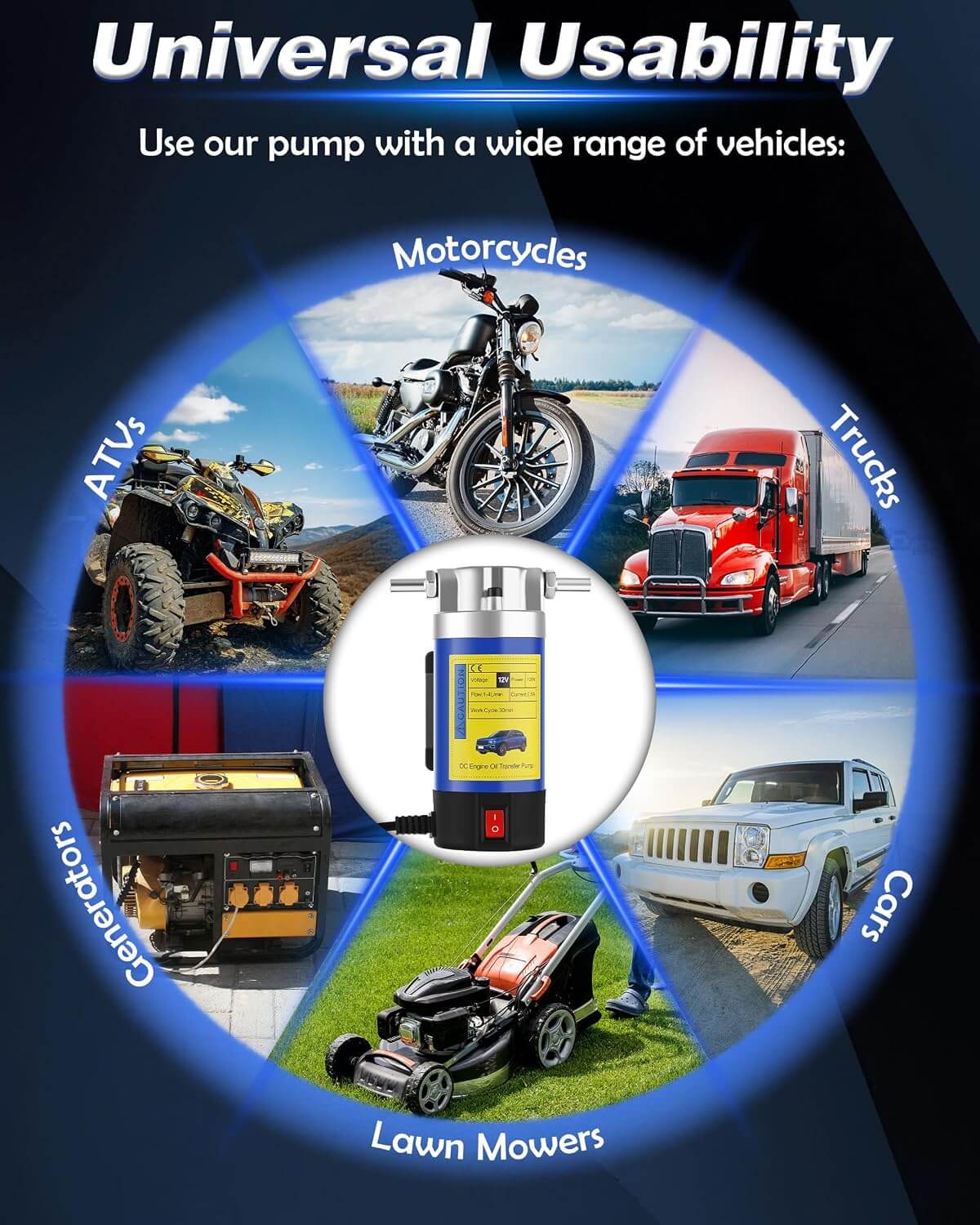
The car is only the start. Anything with a dipstick tube or a fill tube you can reach is fair game.

-
Cars and trucks
Skip the jack, the stands and the splash shield. If your oil filter sits on top of the engine, the whole oil change happens from above.
-
Boats
Most inboards and sterndrives leave no room for a drain pan, and nobody wants oil in the bilge. Pull it out through the dipstick tube, at the dock or on the trailer.
-
Lawn mowers
Leave the mower on its wheels. No tipping it over, no oil soaking the air filter, no cloud of smoke on the next start.
-
Motorcycles
Feed the tube in through the oil filler. No drain pan balanced under the bike and no oil on the pipes.
-
Watercraft
On a personal watercraft the engine sits deep in the hull, where no drain pan fits. The dipstick tube is the way in.
-
Small engines
Pressure washers, generators, snow blowers. Small four-strokes rarely have a drain you can reach without making a mess.
It’s not just for motor oil. It also pulls gear oil, differential fluid and transmission fluid, which is a real help when there’s a fill hole but no drain plug. Overfilled the engine by half a quart? Pull the extra back out in a minute.
Putting something away for winter? Change the oil first. Used oil carries acids and moisture that can pit bearings while an engine sits. That’s why marine mechanics change it before layup, not in spring.
Why not just pull the plug, or buy a hand-pump extractor?
The drain plug puts you under the car. A hand-pump extractor keeps you on your feet but makes your arm do the work. This one sits in the sweet spot.
| Compare | This pump | Drain plug | Hand pump |
|---|---|---|---|
| Go under the car? | No | Every time | No |
| Your effort | Clip on and watch | Jack, crawl, wrench | Pump by hand |
| Drain plug risk | None | Strip it or leak | None |
| Where the oil goes | Hose to jug | Open pan | Tank to empty |
| Power | 12V battery | None | Your arm |
| Stores in | A drawer | Jack, stands, pan | 6-liter tank |
An extractor’s clean hands, without the pumping.
Or keep paying the shop?
A full-synthetic oil change at a shop runs about $65 to $125. The same oil and filter cost about $35 to $55 when you do it yourself. That’s $30 to $70 back in your pocket every time, with no appointment and no upsell. The pump usually pays for itself within the first two oil changes.
One for your garage. One for his.
Know a guy who changes his own oil? Then you know a guy who’s tired of crawling under the car to do it. Your dad, whose knees have earned a break. Your brother. The neighbor who keeps borrowing your jack. Keep one on your shelf and put a bow on the other.
Got a boat at the lake? Leave the second one in the dock box, so there’s a pump wherever the engine is.

The gift he’ll actually use. No sizes to guess and no batteries to buy. He’ll put it to work at his very next oil change, and think of you every time he doesn’t have to get on the floor. A practical pick for Christmas, birthdays and Father’s Day.
Why it earns a spot on the shelf
- Keeps you on your feet and the car on the ground
- Leaves the drain plug alone, so it can’t strip or leak
- Moves old oil from engine to jug without an open pan
- Pure copper 100W motor that pulls on its own, with no hand pumping
- Runs off the 12V battery you already own
- Works on cars, boats, mowers, motorcycles and small engines
- Backed by our money-back guarantee
Specs and what’s in the box
| Power | 12V DC, about 8 A |
|---|---|
| Motor | 100W, 100% pure copper windings |
| Flow rate | Up to 4.2 qt/min (1 to 4 L/min)* |
| Run time | Up to 30 minutes continuous |
| Oil temperature | 50 to 194°F (10 to 90°C) |
| Priming | Self-priming |
| Pump length | About 7 in (18 cm) |
| Fluids | Motor oil (conventional and synthetic), gear oil, differential fluid and transmission fluid. Not for gasoline, diesel or water. |
| Fits | Dipstick tubes and fill tubes that accept a 1/4" (6 mm) tube |
In the box
- 12V oil extractor pump with battery clips
- 1/4" × 2.6 ft (6 mm × 800 mm) dipstick tube
- 5/16" × 3.3 ft (8 mm × 1,000 mm) inlet hose
- 3/8" × 3.3 ft (10 mm × 1,000 mm) outlet hose
- Inlet connector, hose connector, outlet clamp and 2 fitting screws
Not included: a container for the old oil. An empty 5-quart oil jug with a cap works great.
*Maximum rated flow. Real flow through the thin dipstick tube is lower and depends on how warm and how thick the oil is.
Good to know before you order
- Oils only. Motor oil, gear oil, differential fluid and transmission fluid. Never gasoline, diesel, water or anything flammable or corrosive.
- Warm, not hot. Run the engine 3 to 5 minutes first. Cold oil is thick and slow, and oil straight off the highway is too hot. The pump is rated for oil between 50 and 194°F.
- It needs a way in. Your engine needs a dipstick tube or fill tube that a 1/4" (6 mm) tube can slide down. The tube is 31.5 inches long, so dipsticks longer than about 28 inches may be too deep. Some newer European cars have no dipstick tube at all.
- The filter still gets changed. With a top-mounted filter, you do the whole job from above. If yours sits underneath, you’ll still reach for it, but there’s no drain plug to pull and no gush of oil.
- A few ounces may stay behind. On most engines the tube reaches the low point of the pan and pulls about what the drain plug would. Some pans leave a few ounces, and a few baffled pans leave more.
- 30 minutes, then a rest. That’s the longest it should run without a break.
- Bring a jug. The pump moves oil. It doesn’t store it.
Frequently asked questions
Does it really get all the oil out?
On most engines, very nearly. The dipstick tube ends near the bottom of the pan, so the pump pulls about what the drain plug would let out. Some engines leave a few ounces behind, and a few with baffled pans leave more. For the best result, park on level ground, warm the oil and push the tube down until it stops.
Will it work on my car?
If your engine has a dipstick tube that a 1/4" (6 mm) tube can slide down, it should. Check two things. Your dipstick should be shorter than about 28 inches, so the 31.5-inch tube can reach the bottom. And the clips need to reach a 12V battery. Some newer European cars have no dipstick tube at all, and those won’t work.
What about the oil filter?
It still gets changed. If your filter sits on top of the engine, as it does on the Pentastar V6, Subaru’s FB engines, GM’s Ecotec four-cylinders and many Mercedes and BMW engines, you can do the whole oil change from above. If it’s underneath, you’ll still reach for it, but there’s no drain plug to pull and no gush of oil to dodge.
Do I have to warm up the engine first?
Yes. Run it for 3 to 5 minutes, then shut it off. Warm oil is thin and comes out fast. Cold oil is thick and slow. If you’ve just come off the highway, let the engine cool for a while, because the pump is rated for oil between 50 and 194°F.
How long does it take?
With warm oil, most car engines are empty in about 5 to 10 minutes. Small engines like mowers hold far less and go much faster. Thicker oil, colder oil and deeper dipstick tubes all slow things down.
Will it drain my battery?
No. It draws about 8 amps, so a 10-minute oil change uses roughly 1.4 amp-hours. That’s a sliver of what a healthy car battery holds.
My mower has no battery. How do I power the pump?
Clip it to any 12V battery. Most people roll the mower up next to the car and use the car’s battery, or keep a spare 12V battery in the garage. Boats and riding mowers can use their own.
Can I use it for gasoline, diesel or water?
No. It’s built for oils only: motor oil, gear oil, differential fluid and transmission fluid. Never pump gasoline, diesel, water or any flammable or corrosive liquid.
Does it handle gear oil and transmission fluid?
Yes, and it’s a big help on differentials and transmissions that have a fill hole but no drain plug. Thick fluids need to be warm, so take a short drive first. Very heavy gear oil that’s cold will barely move.
How do the hoses connect?
On the inlet side, the 5/16" hose attaches to the pump’s inlet fitting with the black inlet connector. The thin 1/4" tube joins the other end of that hose with the black hose connector, and it’s the part that goes down the dipstick tube. On the outlet side, the 3/8" hose slides onto the outlet fitting and locks down with the yellow clamp. The hoses arrive coiled, so a few minutes in warm water or in the sun helps them relax.
There’s a little oil in my new pump. Is it used?
No. Every pump is test-run at the factory with a few drops of light oil before it ships, so a little residue in the ports is normal. It means your pump was checked.
What do I do with the old oil?
Pump it straight into a jug with a cap. An empty 5-quart oil jug is perfect. Most auto parts stores, including AutoZone, O’Reilly and Advance Auto Parts, take used motor oil for free. Call ahead to be sure.
Is pulling oil out this way bad for the engine?
No. You’re removing the same oil through a different opening. Nothing on the engine is modified, and the drain plug stays sealed. As with any DIY oil change, keep your receipts for the oil and filter.
You’ve pulled your last drain plug.
Warm up. Tube in. Clip on. Then pour in the fresh oil and get on with your weekend.
Choose your bundle- Money-back guarantee
- Secure checkout
- Worldwide shipping